Tuesday, October 16, 2012

Starting with the Basics

Undoubtedly, the most reasonable area of chemistry to start in our discussions lies in the elements that compose of all matter. Were these elements that we know about discovered or created?

First, one might expect all of the elements to have been "discovered," since humans did not first "create" such elements such as oxygen or hydrogen. Furthermore, many elements that had been artificially synthesized-- such as Technetium (Tc)--  had been found to be naturally occurring also. So is this area of chemistry actually a simple series of discoveries?

Not quite. (Of course, chemistry would not let us off that easily.) The key phrase in that previous paragraph is the reference to "many [synthesized] elements." In fact, there are elements which we know of solely by synthesis. The most recent example is about Element 117, which was successfully synthesized on 2010.

Temporarily named ununseptium (Uus), the element is one of the heaviest element that we know of. 
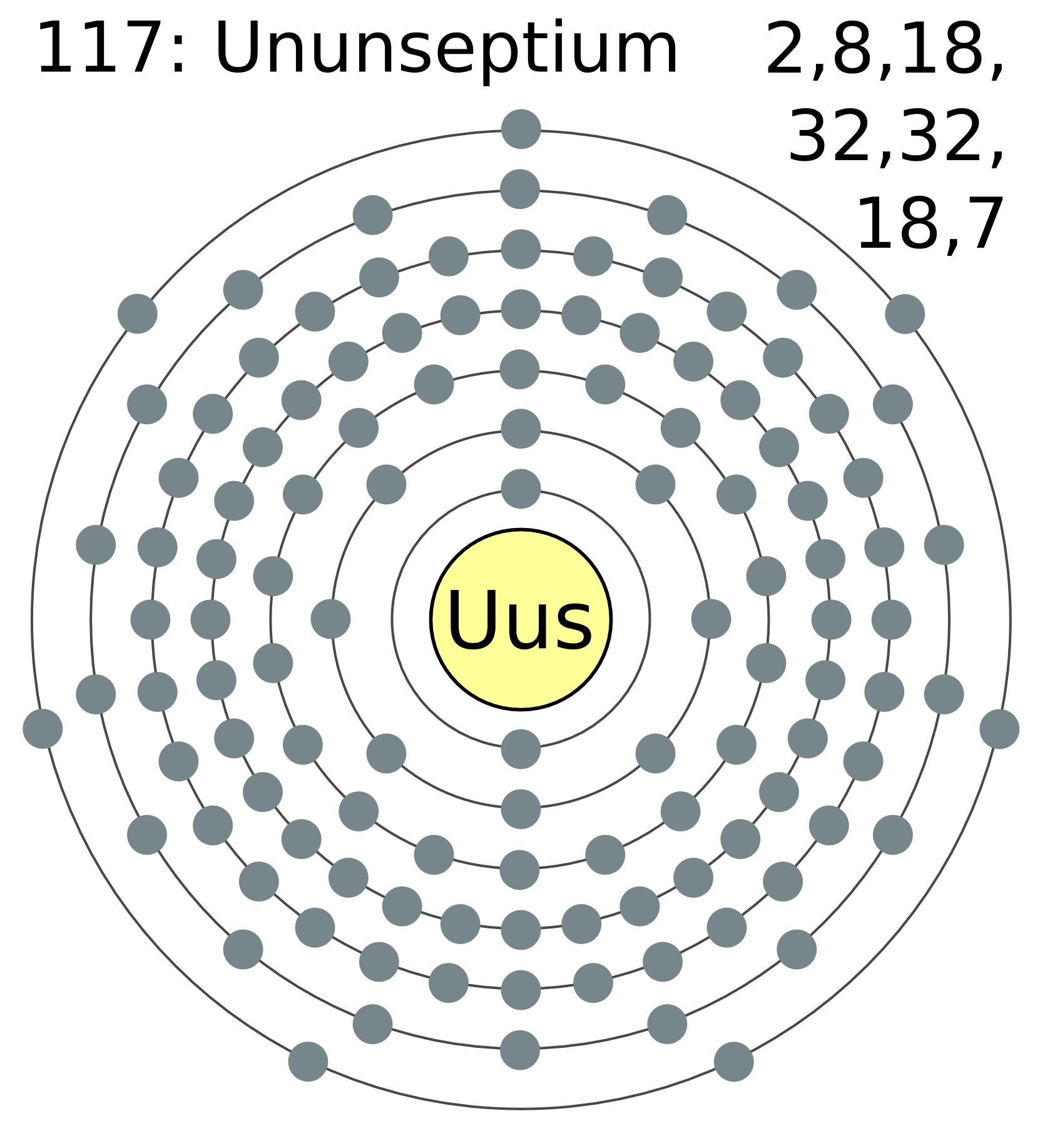


(A Simplified electron cloud model of ununseptium: each dot represents an electron, and each number on the top right corner denotes the number of electrons in each "ring," starting from the inner-most one)


The team responsible for the element had smashed isotopes of calcium and radioactive berkelium in a particle accelerator, in order to create a mere 6 atoms of Element 117 (which lasted for a fraction of a second), marking the first recorded "discovery" of ununseptium as The New York Times had labeled it. Yet is it truly a discovery?

As we defined previously, a discovery involves "unknown" materials. Although some specific details of the element had not been known, at least the general possibility of the concept had been known since the creation of the periodic table. For example, we knew that a theoretical Element 117 would have 117 protons. Moreover, this element had not been "found" like how other elements such as oxygen had been found (for instance, this was not found in a "natural surrounding"). But most importantly, the team that created the element had planned and used specific procedures to form the element that did not exist beforehand. This directly correlates to the definition of "create."

Therefore, we can see that artificially synthesized elements such as Uus are more results of creation than discovery; yet nonetheless other "naturally occurring" elements are results of discovery than creation. It is very perplexing to see that even in the realm of the basic building blocks of chemistry-- the world of elements-- the conflicting distinctions between discovery and creation is evident. 

On a last note, Dr. Kenton Moody, a member of the team that created Uus, declared that,
The question we’re trying to answer is, ‘Does the periodic table come to an end, and if so, where does it end?’
His question reveals yet another in response, which we will leave as an open question for now: Is there a limit to such achievements of creation, or are we bounded by the things we can discover?

Before We Start

So obviously, the question posted earlier (whether chemistry is discovered or created) is much more complicated than a simple yes or no question. To even begin to answer this, we need to explore and sort through numerous branches of chemistry-- both deeply and carefully. But first, and perhaps most importantly, we need to clarify what we specifically mean when we say that something is "created" or "destroyed."  

In general, dictionary.com provides the following definitions:

Discovergain sight or knowledge of (something previously unseen or unknown)
Createto cause to come into being, as something unique that would not naturally evolve or that is not made by ordinary processes.
Basically, the distinction lies in the fact that creation revolves around the formation of previously nonexistent materials or ideas by humans and our invented "processes," while discovery relies more broadly on finding unknown substances or concepts. We will discuss the context of chemistry around these definitions, at least for now.


Just as importantly, we need to establish why this distinction even matters, in a practical sense. You might be asking yourself, "Does the difference significantly and tangibly affect applications of chemistry in our world?" And the answer is yes, beyond doubt.

The ethical dilemmas that the question of discovery or creation can prove to be vital in the realm of chemistry. By differentiating and classifying different aspects of chemistry under the two categories, we protect ourselves from the arrogant delusions that humans are the creators and the centers of the world (which result in major blockades to scientific advancements); we must prevent the scene that philosopher Immanuel Kant described as the current, disappointing actions of humankind: "Our intellect does not draw its laws from nature but imposes its laws upon nature." At the same time, we realize through such discussions the purpose of chemistry-- to study the "discovered" and balance them with our own "creations" in order to behoove the welfare of all life. 

With this in mind, we begin our journey on the synthesis of symmetry-- discovered or created 

Wednesday, October 10, 2012

Opening Post

Hello, welcome to our blog!

In this blog, we will be addressing a variety of topics regarding the synthesis of symmetric molecules, ranging from the process of forming these molecules to their practical applications. Ethical considerations throughout each process will also be discussed.

In addition, we will also be addressing a key topic, which we'll leave as an open question for now:

Is chemistry discovered or created?