Sunday, January 20, 2013

What is Group Theory?

So we've been talking about "symmetry operations" and "group theory" and "elements" and such (and if you don't remember, read back a few posts or check out this very helpful video:


Wait...but what exactly is group theory?

Well, in general group theory is just the study of a group of stuff, connected by a central "operation"-- in laymen's terms. More specifically, it explores the relationships among each "element" with respect to each other.

A formal "group" just has elements that have four types of relationships:

1. There needs to be an "identity" operation.

2. When an operation is applied to two elements, the resulting element must also be in the group (Closure).

3. Associativity (just like in math) has to hold.

4. For every element, there has to be an element that, when operated together, result in the identity (inverse).

Woah, that's a lot of complicated jargon. Let's get back to this later.

First, we need to establish which specific group we're talking about, when we refer to group theory in chemistry (again, click on the image to enlarge):


Here is another, nicer way or categorizing these groups:


If this still confuses you, have no fear: An online lecture by Claire Vallance of the University of Oxford provides a simple flowchart that will direct you to the group that you need:


So for the most part, the tables and diagrams above provides a clear definition of what each group stands for. For example, the C1 group refers to molecules without any of the symmetries we talked about before, like this one:


This molecule is lysergic acid, with chemical formula C16H16N2O2. Clearly, you can't see any type of symmetry in this molecule-- no reflections, rotations, or inversions are possible...Well, except for the identity (E), which is present in ALL molecules. And so, this group of molecules is rightfully called C1, since C1 is a rotation by 360/1=360 degrees.


Now let's see if each group here meets all of the conditions that we mentioned above! For example, we know that each element has the "E" symmetry, which meets Criterion #1.

Well, long story short, the answer is-- yes! In fact, each group does meet all of these criteria!

The remarkable thing here is closure: this means that if we do two operations on a molecule, it's equivalent to one operation, which may or may not be different! Let's look at this chart:
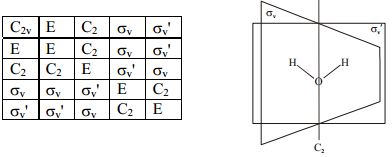


As you might have guessed, these are the elements that comprise of the C2v group! This table shows us that if we do two operations (first the column operation, then the row operation), we get an orientation equivalent to one single operation! Pretty cool, huh? This is just the beginning of the wonders of group theory.

One last note: In fact, many of these groups also correspond to the different 3-D shapes in the Valence Shell Electron Pair Repulsion (VSEPR) Theory:


That can't be a coincidence...can it? We leave that as a temporary open question to the reader.

Sunday, January 13, 2013

Group Theory - Part 2

A few days ago, we began to talk about how math and the concept of group theory came in play with symmetric molecules!

To recap: we assign different types of symmetries with different notations so that we can differentiate one from another easily.

Last time, we talked about three of the 5 main symmetries:  The identity, Rotation, and Reflection!

(Here you can see both the reflection planes and the rotation axis of H2O!)

Today we'll talk about the other two:

4) Improper rotation (Sn)

So we know about rotations..but that's an improper rotation?? Well basically, it's a combination of a rotation AND a reflection! Funky right?

As always, it's always best to look at an example:


Here is a ball-and-stick model of methane (CH4). If you look at the two different sides separated by the green plane, you'll notice that we can get to the right side by reflecting it, and then turning it a bit around the green axis! That's the essence behind the improper rotation:
An Sn improper rotation is a reflection followed by a rotation by 360/n degrees.

So in this case, this would be an S4 improper rotation!

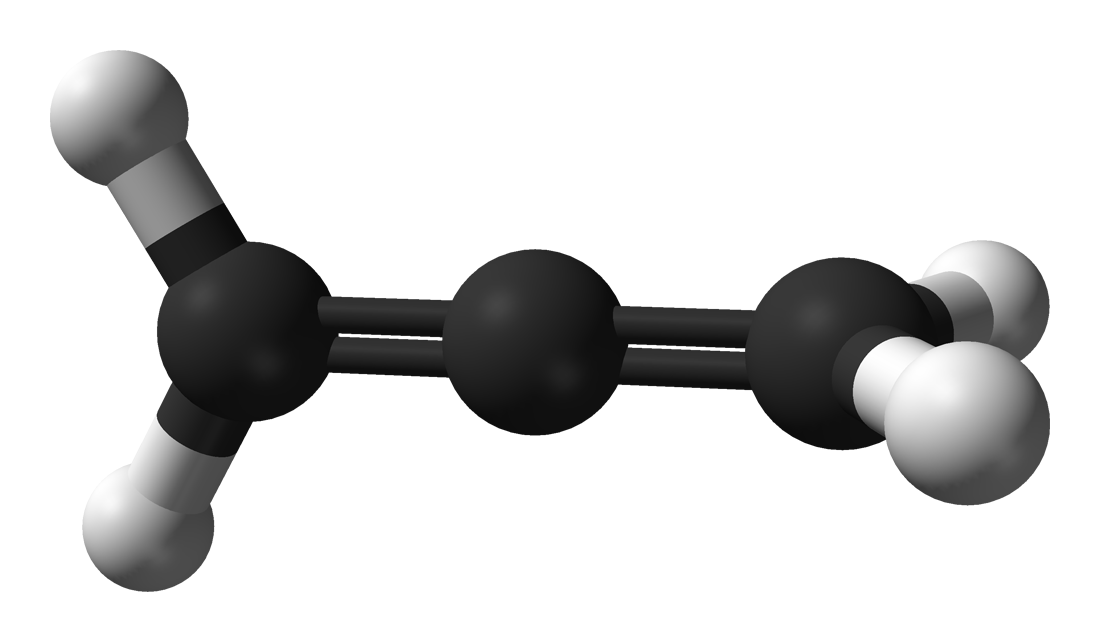
We should note here that, while most molecules with Sn symmetry also have rotational and reflective symmetries, some don't have to! For example, allene (C3H4) has the former but neither of the latter:


You can see how it has S4 symmetry, with the axis through the three carbon atoms and the plane perpendicular to the axis and through the middle carbon. However, it does not have either σ4 or C4 symmetry.

Finally, we arrive at the last (and, to me, the most confusing) symmetry:

5) Inversion (i)

Inversion turns a molecule "inside-out." Basically, if a molecule has inversion symmetry, it has an inversion center. For example, a cube or sphere would have such a center. Similarly, benzene would also have it:


However, other molecules like water don't.

If you're confused, don't worry-- it only gets more complicated.

Having this symmetry would mean that we can arrive at the same molecule by moving each atom of the molecule along a straight line through that inversion center, to a point equally distant from the original position of the atom.

What does that even mean??? Let's find out with an example:


If you see to the right, the ethane molecule has an inversion center, because we can take each of the hydrogen atoms, move it in a straight line through that center, and arrive at one of the other hydrogen atoms!

If that still confuses you, don't worry-- look at the right diagram. In SF6, each fluorine atom moves in line with the center, or the sulfur molecule in this case, and ends up in the position of a different fluorine atom. That's the idea of inversion.

Here are a couple of more examples:


This is a hexacarbonylchromium complex Cr(CO)6. We can clealy see that the center is the Chromium atom, and that each carbon and hydrogen atom can be moved to another of the same molecule.

Easy enough? Well too bad. Here's one that's not so obvious:


This is a staggered 1,2-Dichloroethane (C2H4Cl2) molecule. The center is a bit more hidden in this case, but the picture shows you quite nicely. If you follow the red, dotted line, you'll see that each atom matches the other perfectly. So this has inversion symmetry.

(Also note the S2 symmetry at work here. Coincidence? We encourage the reader to explore.)

Here's where things get funky. Here is eclipsed 1,2-Dichloroethane:


Even though it has the same molecular formula, this one doesn't have the same inversion symmetry! Rather, it has reflective symmetry-- something that the staggered form doesn't have! This tells us that even though molecules may have the same formula, they may have completely different symmetries. We have to be wary of that.

So overall, these are the 5 main symmetries of a molecule: The Identity, Rotation, Reflection, Improper Rotation, and Inversion. This is summed up in the table below:


So, we've finished going over the basics..but now what? Why is this so important? What does this tell us about any properties of the molecule? How can we use this group theory, and what does one symmetry operation have to do with another? We'll continue this journey on a future post.

FerroFluids

        Lets talk about something interesting today. That thing is the marvel of ferrofluids. Ferrofluids are basically magnetic particles suspended within a liquid median using a surfactant. This creates a part liquid, part solid substance that displays superparamagnetism. What? Well in much simpler terms, a ferrofluid is a combination of two states of matter. The solid is connected to the liquid using the surfactant, which basically connects the liquid to the solid. A simple example of this is how soap is able to attach oil with water. Besides that, the surfactant is also the thing that is used to keep the magnetic particles from attaching to each other. Now, we reach the biggest word, superparamagnetism. This word simply means that all the particles are so small that they only have one magnetic dipole, meaning they all ether have a south or north pole. Or just a pole in general since you cant have only a south pole. There are a lot of things that can be done with ferrofluids. In fact maybe you have seen one of those cool towers made from them. 
                                     Strangely symmetric aren't they?

And while those things are cool, they don't really have an practical applications. And knowing what the topic of this blog is, lets give an example of some of the interesting symmetrical stuff that is being test about ferrofluids. 
       The first article is titled Effect of MFD Viscosity and Porosity on Revolving Axi-symmetric Ferrofluid with  Rotating Disk. The name may seem complicated, but it is actually quite simple. First, MFD stands for magnetic field-dependent. To start with, when ferrofluid is rotated, it will usually always display y-axis symmetry or axi-symmetric characteristics. Just look at the pictures above if you don't believe me. So, some scientists decided to apply an outside magnetic field to a ferrofluid that was rotating and in symmetry in order to see 3 things. First, how would its viscosity change, its porosity change, and would the ferrofluid even stay symmetrical. While the last tenet doesn't need defining, the first two do. Viscosity is something's willingness to flow. Porosity is the empty space in something. At the end of the experiment, it was found that despite all the variables that were changed the ferrofluids tended to act in a similar manner no matter what. The thing that I take form this however, is that symmetry is very hard to get rid of, no matter the velocity of the spinning, viscosity, or porosity. 
        It is important to remember why this stuff is so symmetric. And just in case you were unable to gather why from the beginning of this post, I will restate it here. Ferrofluids are not just liquids. They have small magnetic solids just floating around in them. And all these things are very easily influenced by a magnetic field. A magnetic field itself, usually goes from north to south. When the ferrofluids are exposed to one, they are go to a position dictated by the field itself. The surfactant keeps them from getting to close, and there you go, constant y-axis symmetry. Thanks for reading. 

Saturday, January 12, 2013

The Thermodynamics of Symmetrical Bodies

Boltzmann
Flasks with Cohorts
Albert Einstein's "Electrodynamics of Moving Bodies" did encompass symmetry into some mind blowing theories on space and time and what not. But let us remind ourselves, we are humble people in the pursuit of answers in chemistry. But I do conjure up Einstein's miracle year papers to prove my point of the importance of symmetry.  Boltzmann (the handsome devil whose picture is shown above) had a way to calculate entropy based on the number of macro states a substance (let's say gas) can occupy in a cohort. The flasks with their cohorts are also above. There is a way to calculate entropy; it is S=klnW. S is entropy, k is Mr. Boltzmann's constant, and W is the number of macro states. There is a ubiquitous correlation between symmetry and entropy. Entropy very much is a degree of symmetry. Because there are two types of symmetries( dynamic entropy and static entropy) there are two types of entropies, aptly named dynamic entropy and static entropy. 
Everybody, just relax. I'm going to explain the two. Dynamic symmetry is due to dynamic motion like the motion of one individual molecule and static symmetry is due to phase change. It is obvious, looking at the cohorts, that III has more macro states and greater symmetry (the one that has the statistically better chance at happening). A symmetry increase due to dynamic motion is just as apparent. An electron flying in its orbital leads one to conclude that the hydrogen atom is a symmetrical sphere. If the electron did not move as it did, the atom would not be seen as a sphere because of the definite spot of the electron.  

Change in Gibbs free energy can measure whether some process is spontaneous or not. If it is negative, it is spontaneous, if it positive then it is not, and if it is zero then it is at equilibrium. This is the max entropy. At this state, the substance is most susceptible to some internal or external constraints. Constraints like this include polarity and isotropicity. When these changes happen, because of a force or field, the symmetry is reduced as well as the entropy. Our friends in Basel, Switzerland have come up with the perfect platitude: Any system evolves spontaneously toward a maximal symmetry. It is analogous to saying that when I heat up a gas, the entropy is increased because of the higher number of possible arrangements these molecules can be in. But, contrary to common sense and intuition and thermodynamically speaking, the symmetry increases because individually each molecule has more energy and that little electron is moving a lot faster allowing the nuclei of the molecules to look more like spheres. But there are real irking (I like the work irk) constrains like I just mentioned. The van't Hoff factor (bringing these gas molecules closer together and restricting their degrees of freedom) are the constrains that reduce the symmetry. The point is that that these gas molecules are indistinguishable from one another and that is why the apparent disorder has nothing to do with our discussion on symmetry. I can attest to the fault reasoning that symmetry is disorder. We can say a sphere is perfectly symmetrical because if we rotate it an infinite number of ways, it is distinguishable from all views.  Mathematically, it boils down to this equation: S=lnN! where N! is the total permutation symmetry number.  We have all heard about the heat death of the universe, where the universe (as entropy inexorably increases) will stop at the point where entropy of the universe is maximum. This goes along with the Big Crunch Theory of the death of the universe where the reverse of the Big Bang will happen, essentially. In the fist scenario, the entropy of the universe is max. and in the second, the symmetry of the universe is max. (as everything will be in the singularity). Both are end of universe scenarios (how poetic).  Hope you have enjoyed this look into the relationship between entropy and symmetry (for a while, people have been asking me what's their story, you know are they dating or something but it hasn't been until now that their relationship has been explained in terms of end of time scenarios). 

Wednesday, January 9, 2013

Symmetrical Hydrogen Bonds v2

In one of our prior posts, we left off without mentioning how symmetrical "hydrogen bonds" are created. We mentioned that "hydrogen bonds" are incredibly strong, but these symmetriacl "hydrogen bonds" are even superior in strength. This post will serve to detail what makes a "hydrogen bond" symmetrical, and how they are formed.
Symmetric "Hydrogen Bond"

Symmetrical "hydrogen bonds" have the potential to be one of the strongest bonds, but what makes a regular "hydrogen bond" symmetrical? A study conducted at Yale University in October of 2012 by Schley involved analyzing iridium (III) alkoxides to determine what gives rise to a symmetrical "hydrogen bond". Utilizing x-ray diffraction, he found, along with his coleagues, that very short hydrogen bonds with O···O distances of 2.4 angstroms exist. After a series of calculations, Shley uncovered that a shorter O···O bond distance will give rise to a symmetrical hydrogen bond.


Symmetrical "Hydrogen Bonds" in Iridium (III) Aloxides
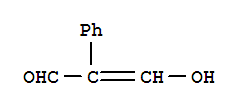
One method which attempts to prove that hydrogen bonds are asymmetric is called the NMR, nuclear magnetic resonance, method. It is illustrated with 3-hydroxy-2-phenylpropenal and then applied to
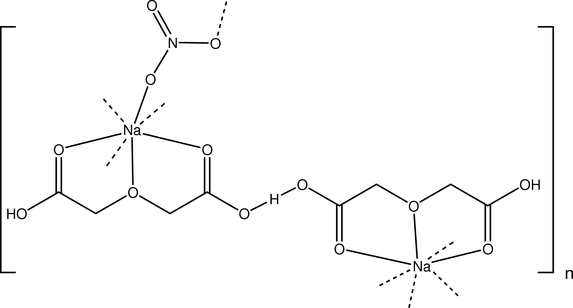
dicarboxylate monoanions. Resulting from this analysis is that the intramolecular "hydrogen bonds" are asymmetric, although can become symmetric in a crystal structure.

3-hydroxy-2-phenylpropenal

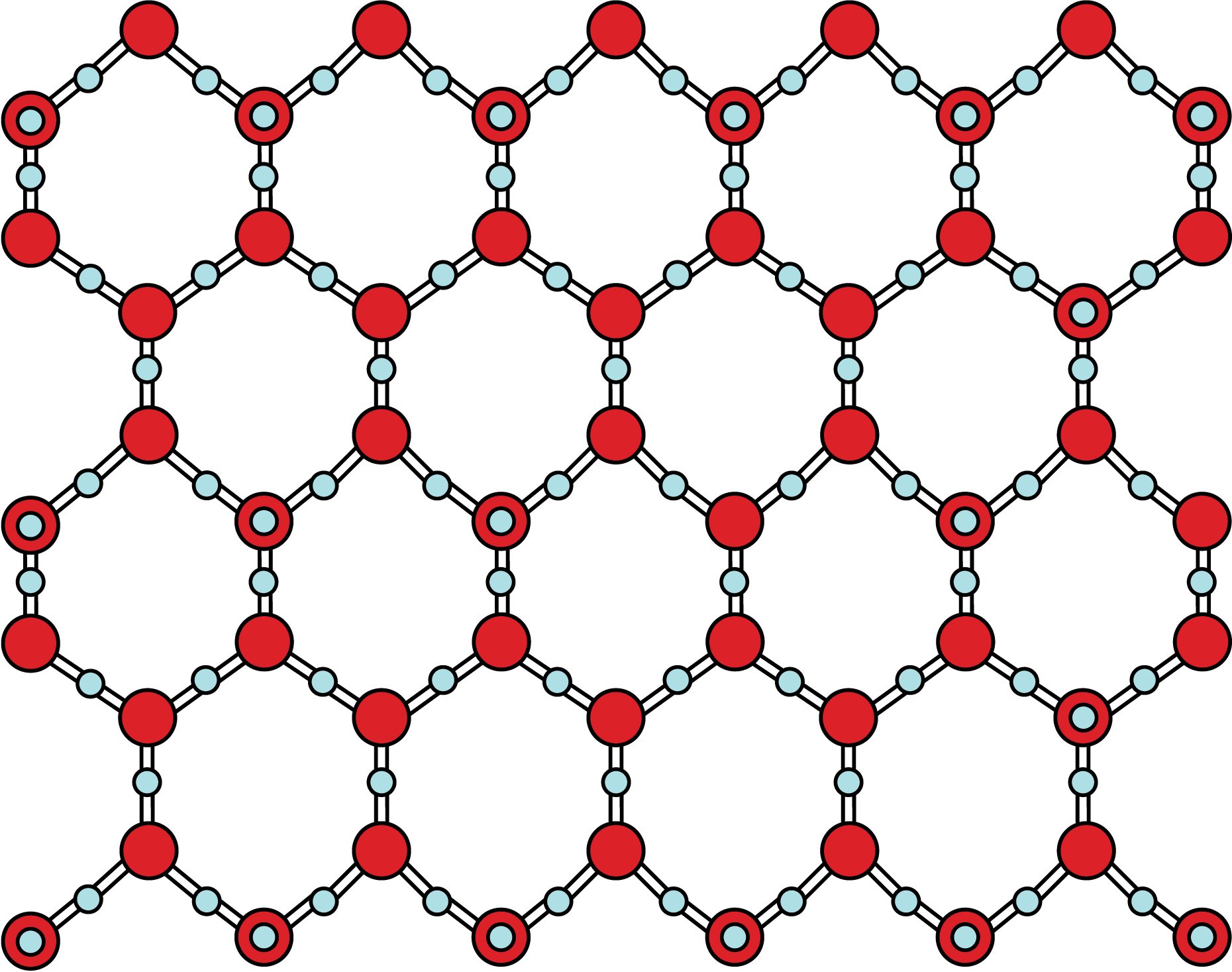
Another article by Charles Perrin states that symmetrical "hydrogen bonds" can occur only in a crystal. He supports this claim by stating that a disorded environment, in solution, will produce an asymmetric bond. However, crystals, such as when water is in its solid phase existing as ice, can guarantee symmetry. So does this mean that symmetric hydrogen bonds can occur only in the solid phase, and never in the gas or liquid phase?

Crystal Structure of Water


A paper entitled "A neutron scattering study of strong-symmetric hydrogen bonds in potassium and cesium hydrogen bistrifluoroacetates: Determination of the crystal structures and of the single-well potentials for protons" demonstrates how "hydrogen bonds" are stronger when in their symmetric, crystalline form. Potassium and cesium hydrogen bistrifluoroacetates emphasize the covalent element of the O···O bond as well as the ionic nature of the hyrogen proton bond. The resulting of this combination of pairing is an incredibly strong bond.

A Hydrogen Bistrifluoroacetates
As a result of these three different studies, we are left with a symmetric "hydrogen bond's" whose strength exceeds that of a regular "hydrogen bond". There are three elements that must be met if we wish for this "hydrogen bond" to be symmetric:
      1. "Hydrogen bonding" must occur in the molecule (this is sort of assumed if we are talking about symmetric "hydrogen bonding"
      2. The O···O bond distance must be as small as possible
      3. The molecule containing the hydrogen bonding should be in a crystal form


Strong Symmetric "Hydrogen Bond"


With all of these conditions met, a regular, rather strong, "hydrogen bond" becomes an incredibly powerful symmetrical "hydrogen bond"


Friday, January 4, 2013

Math? In Chemistry?

As you might have picked up from before, there are several kinds of symmetric molecules! That brings up a huge question-- how do we classify them? How do we differentiate one from another?

Well, that's the purpose of applying group theory in the world of molecules!

Wait a second! Isn't group theory a very advanced mathematical concept? Yes, but it can be applied here in a more simple fashion. This post will cover the basics.

We've touched upon this in one of our earliest blog posts, but it's never bad to repeat something that's so important, right?

In this case, one phrase is crucial to understanding the various types of symmetry:

"A Symmetry operation is an operation which brings an object into a new orientation which is equivalent to the old one."

So for example, in the BF3 molecule below,


we can rotate the shape around the center by 120 degrees. That would change where the atoms go, but it would still maintain the same form. So that rotation would here be a symmetry operation.

There are 5 main symmetry operations involved with molecules:

1) The identity (E)

This is what several people would call a "trivial" operation. Basically, it's doing nothing to the molecule-- that would, of course, keep it in the same form. So every molecule has at least this symmetry operation.

2) Rotation (Cn)

In this operation, we rotate the molecule around certain axes in order to get the same shape back. The axis, depending on the angle that the molecule is rotated by, is called Cn. For example,


as the picture suggests, a rotation by 360/2 degrees around the C2 axis would bring the molecule to the exact same shape! Similarly, rotation by 360/3 degrees around C3 and rotation by 360/4 degree around C4 would both preserve symmetry. 

I hope you realized the pattern: an axis used to rotate the molecule by 360/n degrees is called the Cn axis.

In addition, the operation itself is also called Cn

Here are some more examples:


In this famous H2O molecule, we can see that rotating it by 180 degrees around the axis in the middle would make it the same shape! Hence, this molecule has rotational symmetry.


This time, we have something more complicated! There are two different types of rotational axes in this molecule of benzene (C6H6). We can rotate it by 60 degrees around the center Caxis or by 180 degrees around the C2 axis to get the same hexagonal shape.

Another thing to note here is this-- how many C2 axes do you think there are? I'll give you a moment to think.


Well if you answered 6, you're correct! There are three that intersect through opposite sides-- such as the one shown in the picture, and there are three more that intersect through opposite vertices! That makes 6 whole axes of just C2. This just shows you that a molecule doesn't need to just have one type of rotational symmetry.

Oh, and one more thing-- the Cn axis with the highest value of "n" is called the principal axis.

3) Reflection (σ)

Reflection is also relatively straight forward-- it's just reflecting the molecule across certain planes.

There are three types associated with this symmetry operation: 

          1) Vertical (σv): In this case, the plane of reflection is parallel to the principal axis. Here's an example:


In this ammonia molecule, the plane shown in yellow contains the principal axis. Since reflecting it across that plane would result in the same shape, this molecule is vertically reflective. (That specific reflection is also called σv.)

(If you want to see an interactive, 3-D version of this, click here.)

          2) Horizontal (σh): In this case, the plane is perpendicular to the principal axis. 


Before, we saw that benzene molecules have an C6 rotation axis, which is the principal axis in this case. So the plane shown here would count as the horizontal plane, since it's perpendicular to that axis. And clearly we can see that reflecting the molecule across this plane gets us the same shape. 

          3) Dihedral (σd): This one's a bit more complicated. In this case, the plane is parallel to the principal axis and bisects the angle between two C2 axes. It's best explained with an example:


In this picture, imagine the C2 axes connecting opposite vertices. We see that the plane bisects the angle formed by two of these axes. Since the plane is also parallel to the principal axis, this reflection counts as a dihedral reflection.

Lastly, notice how the dihedral plane was also the vertical plane! The two do not have to be distinct-- rather, all dihedral planes are actually vertical planes, since dihedral planes must also be parallel to the principal axis.

So far, we've covered 3 out of 5 symmetry operations. We'll continue on with our journey at another time.

Tuesday, January 1, 2013

Starting the new year off with a BOOM!

Hey y'all! I hope that you all had a nice winter break.

We're starting the first post of the year with a bang! 
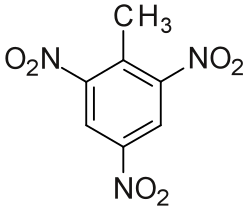
More specifically, we're gonna discuss what makes the bang: explosive molecules such as the well-known TNT (Trinitrotoluene).


(Structure of a TNT molecule)


(Structures of a) methenamine and other explosive compounds; b) RDX; c) HMX; d) HMTD; e) PETN)

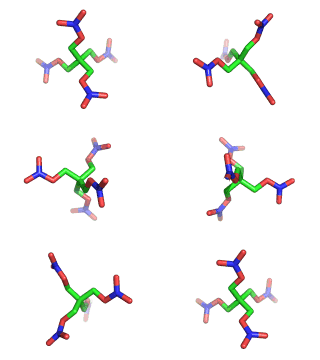
(A 3-D representation of a PETN molecule)

First, as we mentioned above, these are all explosive molecules! All of these materials have at one point been used in warfare, due to their ability to explode readily.

In fact, PETN was used in the recent and infamous incident of the Underwear Bombing in 2009! The terrorist, Umar Farouk Abdulmutallab, was found with 80 grams of PETN sewn into his underwear. 


(The device used in the bombing attempt of 2009. The PETN molecules can be seen in the center.)

But hold on! All of the molecules shown above are remarkably symmetric!! Aren't symmetric molecules supposed to be stable by themselves? Why would they want to explode? And especially why spontaneously?

Well first of all, stability is not the only factor in predicting whether a molecule spontaneously goes into reaction. In fact, that's determined by what's called the Gibbs free energy, notated with the letter G. It basically refers to the amount of energy that can be used to do work, and the equation for this energy is described below:


The ΔH represents enthalpy, the T represents temperature, and the ΔS represents entropy. 


In general, if ΔG is negative, the reaction is endergonic, which implies that it is also spontaneous! That's what determines it.

In the case of explosives, we see two things:

1) All of the explosive molecules mentioned before are exothermic, meaning that they have negative changes in enthalpy. 


2) All of them also have positive values of entropy

The specific values of enthalpy and entropy for TNT and PETN can be seen below (click on the image to see a bigger picture):


And because of these values, ΔG is VERY negative! This reveals exactly why these symmetric molecules explode so viciously and spontaneously.

But wait-- shouldn't aren't symmetric molecules very "ordered"? They don't look disordered, but why are their entropies so high?

Sadly, if you were thinking that, you've fallen into a trap. If anything, entropy measures how complicated (in a sense) a system is. In this case, we see that these molecules are all actually very complicated, especially compared to their decomposition into fairly simple gases!

For example, PETN starts one of its forms of decomposition in the following way:


(This process, in which nitrogen dioxide is separated, happens rapidly throughout its decomposition.)

Its ultimate forms of decomposition can be seen below:


We can see that eventually, the entire, complicated molecule turns into mere carbon dioxide, carbon monoxide, water, hydrogen gas, nitrogen gas, and other basic molecules!

Lastly, what's even more shocking is that these symmetric molecules aren't even as stable as we thought! Although they are perfectly symmetric, they are actually restricted in movement! Thus, when they are triggered, they rearrange themselves rapidly, releasing these more stable products. 

All of this shows exactly why and how explosives create the BANG that we know of.


(Explosion caused by TNT)

What a shocking turn of events-- who knew symmetry wasn't always the desired form of molecules?